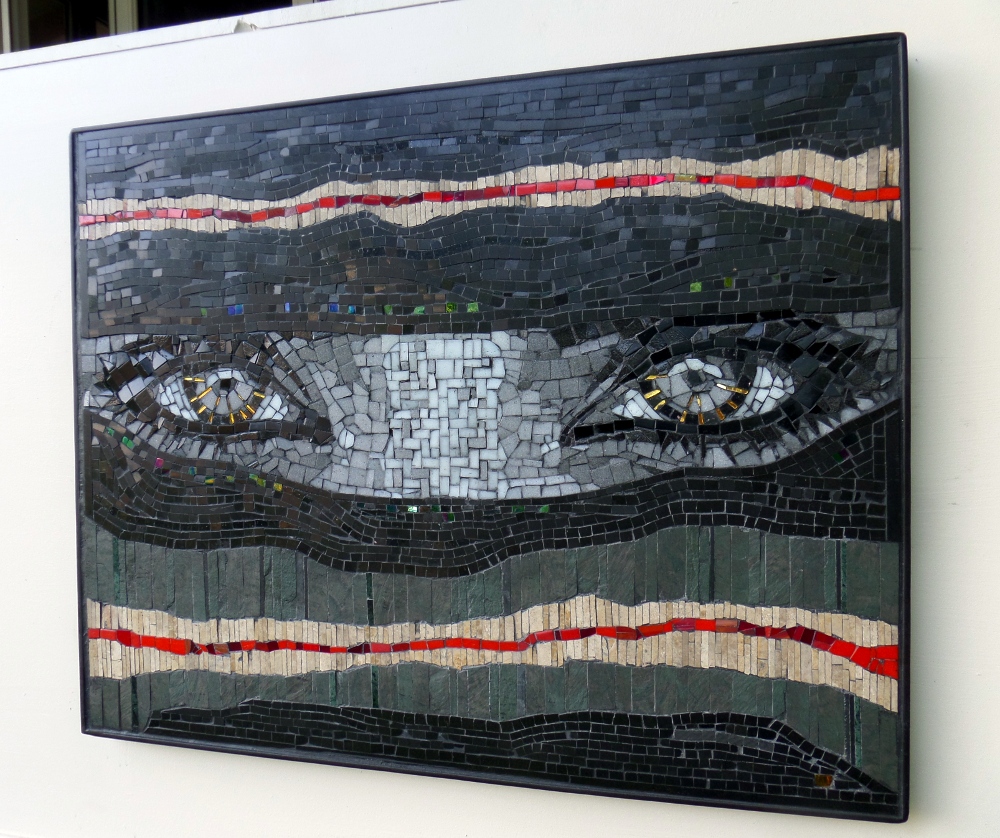
Just wanted to share with you this cool article about the Show Made in Alabama hosted by the Wiregrass Museum of Art. I feel very honoured to have been chosen to be part of this exhibition, in company of 7 other very talented artists.
"Made in Alabama"
Exhibit puts spotlight on Alabama Art.
By Peggy Ussery - Accent writer - The Dothan Eagle
Friday, May 6, 2016
 | |||
| "Grenadier Tree of Life" by artist Frederic Lecut, |
“Made in Alabama” will be at the Wiregrass Museum of Art through June 25.
The eight featured artists are not all Alabama-born, but they all
currently live and work in Alabama. The exhibit was timed with the
Alabama Department of Tourism’s Year of Alabama Makers, a marketing
campaign highlighting the state’s craftspeople, musicians, writers,
designers, artists and even brewers, distillers and food producers.
“Alabama’s known for food, music and, of course, sports,”
said Lara Kosolapoff-Wright, the museum’s communications
coordinator. “I think people are amazed when they learn about all
the incredible artists who are nationally-known,
internationally-known, living in our state.”
Here is a look at the eight artists in the Dothan exhibit:
Butch Anthony, Seale
Folk artist Butch Anthony is known for his bizarre creations that
often incorporate found objects. He has a drive-thru museum off U.S.
431 in Seale, just north of Eufaula, as well as the Museum of Wonder
containing found oddities. For a price, you can have a plaster cast
of a supposed Bigfoot footprint or a feather from the World’s
Oldest Chicken. On Fridays, Anthony hosts the Possum Trot junk
auction.
On his website, www.museumofwonder.com,
Anthony clearly states that he only builds “weird stuff.”
His mixed media pieces on display in the “Made in Alabama”
exhibit include prints of the famous “Pinkie” and “Blue Boy”
paintings with Anthony’s odd touch ‒ skeletal drawings over the
paintings.
Katie Baldwin, Huntsville
A printmaker and book artist, Katie Baldwin used a traditional
Japanese woodblock technique, known as moku-hanga, to create her
pieces on display at the Wiregrass Museum of Art. An assistant
professor of art, Baldwin teaches printmaking at the University of
Alabama in Huntsville.
As an artist, Baldwin has exhibited in Tokyo, Japan, as well as
Philadelphia and San Francisco. Her work is also in permanent
collections, including the Library of Congress in Washington, D.C.
Doug Baulos, Birmingham
Dictionary pages, porcelain, thread and found objects are listed
as the materials used in Doug Baulos’ piece “White Winter
Wreath.” It’s a large piece comprised of multiple objects,
including a semi-circle of birds clinging to the wall.
Baulos is an assistant professor of drawing and bookmaking at the
UAB College of Arts and Sciences. In his work, he uses pages from old
printed dictionaries, which are decreasing in numbers with the shift
to online dictionaries. The pages become nests for birds and wreaths
in Baulos’ art. His work is described as a reflection loss,
mortality and memory.
Cal Breed, Fort Payne
With 20 years of working with glass, artist Cal Breed finds
inspiration for his blown glass sculptures in the natural world.
His pieces in the “Made in Alabama” exhibit include “Walnut,”
a very large glass walnut (juxtaposed with the real thing), a
glass-and-enamel pieced called “Pineheart,” and the
lunar-inspired “Wax and Wane.”
“It’s like the moon and a dinosaur egg all at the same time,”
Kosolapoff-Wright said.
Breed and his wife, Christy, opened Orbix Hot Glass in 2002.
There, the artist creates both his art sculptures as well as
functional pieces such as pitchers, vases and bottles, ornaments and
paperweights.
Natalie Chanin, Florence
A clothing designer from Florence, Natalie Chanin is the founder
and creative director of Alabama Chanin, a company known for its
sustainable practices and described as a company based on “slow
design” principles.
Alabama Chanin uses organic cotton and creates clothing designed
and sewn in Florence. The business also features a store that sells
home products such as kitchenware, aprons, cookbooks, bedding and
ceramics. A café serves lunch and dinner. Workshops are held
throughout the year, catering to sewers and crafters.
Chanin’s pieces featured at the Wiregrass Museum of Art are
hand-sewn organic cotton jersey. In a rich indigo color, the fabric
features hand-stitched designs.
Frédéric Lecut, Headland
Born on the northern coast of France, Frederic Lecut moved to
Alabama in 1992. He began working with mosaics in 2003 after meeting
a mosaic artist in Provence. In that time, Lecut has used his skill
on community projects and public art installations.
Lecut created his pieces “Red Scarf” and “Grenadier Tree of
Life – Alchemy” with colorful tiles for an almost stained-glass
appearance.
Along with Lecut’s own mosaic art, the exhibit includes
workshops hosted by the Wiregrass Museum of Art on May 12 and May 26.
Attendees will produce smaller pieces to be used in a larger
installation.
Miriam Norris Omura, Birmingham
Born in England, Miriam Norris Omura weaves and unweaves images
taken from photos to give her pieces their impact.
The artist uses family photos as well as found photos for her dyed
woven portraits, sometimes even incorporating the original photo into
the woven work.
The result is striking. Omura weaves the image from a photograph,
unweaves it and then weaves it again for a blurred double image. The
portraits have the ghostly feel of a faded family photograph.
Debra Riffe, Birmingham
A Tupelo, Mississippi, native, Debra Eubanks Riffe uses her
linoleum block relief prints to depict African Americans in rural
Southern scenes. Inspired by the Mississippi of her youth, Riffe’s
prints of everyday life stand out against the white printmaking paper
she uses for a canvas.
She has collaborated with Amos Paul Kennedy Jr. on a project about
civil rights activist Fannie Lou Hamer.
Riffe’s work is featured in the permanent collections of the
Freedom Rides Museum at the Historic Greyhound Bus Station in
Montgomery and at the National Historic Landmark 16th Street Baptist
Church in Birmingham.
I
am a modern mosaic artist with a deep admiration for ancient Greek,
Roman and Byzantine Arts. You can see some of my own mosaics on my
site mosaicblues.

If you are interested by my work in general
or
if you would simply like to drop me a line, please
contact me by email at frederic.lecut@gmail.com
or by phone at (334) 798 1639.
You can also