In Southern France Gard, the archaeologists of INRAP bring out the mysterious antic town of Uzès.

Since October 2016 over 4,000 square meters have been methodically dug in the highs of the city of Uzes.
 |
| The excavations in front of the old Gendarmerie barracks |
Nothing was known of the antic Uzès except its name of Ucetia, and that it was the starting point of the aqueduct leading the water from the fountain of Eure to Nimes, through the Pont du Gard.
Initially the archaeologists didn't think it was a major discovery. But the great quality of the vestiges they found testify of the importance of this Roman settlement.
Two magnificent mosaics
In front of the barracks of the Gendarmerie, where once was the vegetable garden of the gendarmes, a row of rooms was cleared, one of which, 60 square meters, has its floor covered with two magnificent mosaics, older than the ones discovered in Nimes.

In the center of a succession of geometric borders a sun like image is surrounded by 5 crowns, themselves framed by four animals: an eagle, a fawn, an owl and... a duck.
 |
| The Eagle |
 |
| The fawn. Note the gorgeous Svastiska border. |
 |
| Minerva's owl ? |
A radiant pattern adorns the medallion of the second mosaic, ornated of a red bordered cartouche at first sight empty. In reality, a name is written in white tesserae on a white background. Who is this Loukios Koinilos? A Lucius Cornilius? Was he the owner of the place, the mosaicist himself, or a patron who'd helped finance the building?
It is not know yet if the building was a domus - a private villa owned by an important man of the city, or rather a public edifice as the dimensions of the hall and traces of colonnade suggest.
What was the symbolism of the mosaics ? Some animals might be attached to deities. The eagle to Jupiter, the doe to Diane, the owl to Minerva. But a Duck...
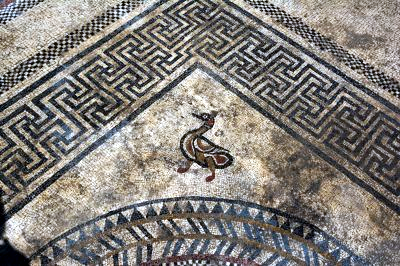 |
| The Duck ??? |
Excavations will continue until August. Hopefully more beauties will be unveiled.
 |
| One of the radiant wheels. |
 |
| Don't you love this border ? |
 | |
| A simple piece embedded in the pavement of a different home |
Frederic Lecut is a French mosaicist.
In 1992 he made Alabama his home.
His Art is about inspiring People.
You can contact him either
by phone at (334) 798 1639 or email at
You can also subscribe to his


