MosaicBlues: duck .entry-content { font-size:25px !important; }
Showing posts with label duck. Show all posts

Sunday, October 8, 2017

3 Roman Mosaics figuring two ducks, a cat and a partridge.


There is a lot to learn by studying Roman mosaics about life in the Empire,  what people liked and disliked, how they lived, worked, died and loved. And of course about the ways of ancient mosaicists.

I believe our ancetors used some sort of catalogs of drawings to show their patrons (I do that !). It is likely some designs were simply copied, there were no copyrights in the Roman times... A few month ago I wrote about the Mona Lisa of Palestine and her copy.

Today lets look at 3 Roman pieces which very much illustrate how people were copying or borrowing each other's designs...


Central panel of a floor mosaic with a cat and two ducks. Opus vermiculatum, Roman artwork of the late Republican era, first quarter of the 1st century BC.
Floor mosaic from a Roman Villa (Rome - Cecchignola)


This piece comes from the triclinium (Banquet room) of a suburban villa of the Cecchignola area is currently visible a the Pallazo Massimo alle Terme - National Museum of Rome 


Roman mosaic representing a cat with a partridge in her mouth above ducks (on the left a male Eurasian Teal, on the right a Common Shelduck), birds, fish and shellfish.
Floor mosaic from the Villa of the Faun, Pompeii

This gorgeous piece from the triclinium of the House of the Faun in Pompeii is visible at the National Archaeological Museum in Naples, Italy.


Roman floor mosaic representing a cat biting a rooster above 2 ducks and fruits
Roman Floor mosaic of unknown provenance.  

This third piece unfortunately of unknown provenance and period can be seen at the Vatican Museum. 

These three pieces are closely related. They are similarly structured as a superposition of 2 scenes. In the upper panel a cat is biting a bird, a partridge in the first two mosaics, a rooster in the third one; In the lower panel two live ducks sit beside various edible material (lotus flowers in the Cecchignola piece; lotus flowers, dead birds and shellfish in the Pompeii piece: olives and apples in the bottom piece).


Emblema pieces were executed by highly skilled craftsmen operating out of specialized workshops. Once completed they were shipped in the whole empire to private or public buildings were other less skillful workers would mount them. There were very few workshops able to produce pieces of this quality. 

While the Pompeii and Cecchignola pieces are of close and excellent quality,  the last piece is of a inferior facture. This leads me to think that the first ones were executed in the same workshop, possibly by the same artist while the last one was executed later, in a different workshop, by a worker of lesser ability. 

How was the design passed from one shop to an other ? 

I believe our ancestors used hand-written and drawn books of patterns that apprentices would copy from their masters. Until archaeologists find and read these documents we won't know! 

If you have any knowledge on this subject, I would be very interested in hearing from you !


I am a modern mosaic artist with a deep admiration for ancient Greek, Roman and Byzantine Arts.


You can see my own mosaics on my site at mosaicblues.  

If you are interested by my work or would like to drop me a line please contact me by email at frederic.lecut@mosaicblues.com or by phone at (334) 798 1639. 


You can also 


Friday, March 31, 2017

Stunning Giant Mosaics unearthed in Uzes, France.


In Southern France Gard, the archaeologists of INRAP bring out the mysterious antic town of Uzès.


Since October 2016 over 4,000 square meters have been methodically dug in the highs of the city of Uzes.

 
The excavations in front of the old Gendarmerie barracks

Nothing was known of the antic Uzès except its name of Ucetia, and that it was the starting point of the aqueduct leading the water from the fountain of Eure to Nimes, through the Pont du Gard. 

Initially the archaeologists didn't think it was a major discovery. But the great quality of the vestiges they found testify of the importance of this Roman settlement.

Two magnificent mosaics

In front of the barracks of the Gendarmerie, where once was the vegetable garden of the gendarmes, a row of rooms was cleared, one of which, 60 square meters, has its floor covered with two magnificent mosaics, older than the ones discovered in Nimes. 


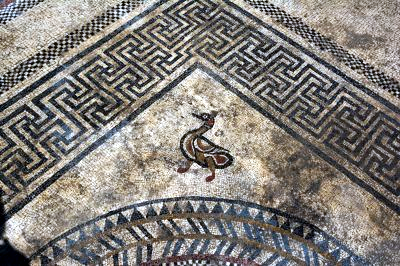
In the center of a succession of geometric borders a sun like image is surrounded by 5 crowns, themselves framed by four animals: an eagle, a fawn, an owl and... a duck.


The Eagle


The fawn. Note the gorgeous Svastiska border.


Minerva's owl ?


A radiant pattern adorns the medallion of the second mosaic, ornated of a red bordered cartouche at first sight empty. In reality, a name is written in white tesserae on a white background. Who is this Loukios Koinilos? A Lucius Cornilius? Was he the owner of the place, the mosaicist himself, or a patron who'd helped finance the building? 

It is not know yet if the building was a domus - a private villa owned by an important man of the city, or rather a public edifice as the dimensions of the hall and traces of colonnade suggest.
 
What was the symbolism of the mosaics ? Some animals might be attached to deities. The eagle to Jupiter, the doe to Diane, the owl to Minerva. But a Duck...


The Duck ???

Excavations will continue until August. Hopefully more beauties will be unveiled. 


One of the radiant wheels.


Don't you love this border ?


A simple piece embedded in the pavement of a different home


Frederic Lecut is a French mosaicist.
In 1992 he made Alabama his home.
His Art is about inspiring People.

You can contact him either 
by phone at (334) 798 1639 or email at 
You can also subscribe to his