MosaicBlues: archaeology .entry-content { font-size:25px !important; }
Showing posts with label archaeology. Show all posts

Friday, October 27, 2017

Long-lost Roman Mosaic built for Caligula and smuggled to the US finally returns to Italy.


The destiny of Works of Art can be surprising !

In the 2015 movie Woman in Gold an elderly Jewish refugeefights the Austrian Government to reclaim a portrait by Gustav Klimt of her aunt Adele Bloch-Bauer, portrait which had been stolen by the Nazis prior to World War II.


This painting, stolen by the Nazis right before World War II, was returned to its righful owner in 2014.
Portrait of Adele Bloch-Bauer by Gustav Klimt


Closer to us, last September, prosecutors seized in New York City a piece of floor mosaic from one of Roman Emperor Caligula’s opulent private ships discovered in 1928 by Italian Archaeologists.


The barge was sunk after Caligila's assassination and retrieved from Lake Nemi in 1928.
One of Caligula's ship discovered in 1928.


The mosaic,
stolen from an Italian museum during World War II was in the possession of an antiques dealer of New York. She had bought it in good faith in the 60’s from an aristocratic Italian family and was unaware of its origins.

For much of the past five decades, the four-by-four piece of mosaic - featuring a complex geometric pattern made of pieces of green and red porphyry, serpentine and molded glass - had been sitting in their Park Avenue apartment, where it was used it as a coffee table.


This mosaic, stolen from an Italian museum during World War II, was returned to Italy in 2017.
The mosaic retrieved from the Caligula Ship


Caligula, whose real name was Gaius Julius Caesar, was emperor between 37 and 41 AD. His short rule came to a bloody end when he was assassinated by officers of the Praetorian Guard, amid a revolt over his terrible behaviour and reckless spending.


The mosaic is on its way back to Italy.
 

In a next post I’ll tell you about a Roman mosaic looted from a Syrian museum by ISIS, which a Turkish smuggler proposed to sell me.


I was contacted by a smuggler from Turkey who asked if I was interested to purchase this mosaic.
Mosaic stolen from a Syrian Museum.


I am a French mosaicist


living in Headland, Alabama, USA.


My Art is about inspiring people.


You can see some of my work 


You can contact me either by phone 

at (334) 798 1639 or by email at 


You can also subscribe to my


Friday, March 31, 2017

Stunning Giant Mosaics unearthed in Uzes, France.


In Southern France Gard, the archaeologists of INRAP bring out the mysterious antic town of Uzès.


Since October 2016 over 4,000 square meters have been methodically dug in the highs of the city of Uzes.

 
The excavations in front of the old Gendarmerie barracks

Nothing was known of the antic Uzès except its name of Ucetia, and that it was the starting point of the aqueduct leading the water from the fountain of Eure to Nimes, through the Pont du Gard. 

Initially the archaeologists didn't think it was a major discovery. But the great quality of the vestiges they found testify of the importance of this Roman settlement.

Two magnificent mosaics

In front of the barracks of the Gendarmerie, where once was the vegetable garden of the gendarmes, a row of rooms was cleared, one of which, 60 square meters, has its floor covered with two magnificent mosaics, older than the ones discovered in Nimes. 


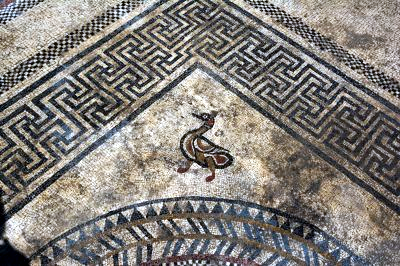
In the center of a succession of geometric borders a sun like image is surrounded by 5 crowns, themselves framed by four animals: an eagle, a fawn, an owl and... a duck.


The Eagle


The fawn. Note the gorgeous Svastiska border.


Minerva's owl ?


A radiant pattern adorns the medallion of the second mosaic, ornated of a red bordered cartouche at first sight empty. In reality, a name is written in white tesserae on a white background. Who is this Loukios Koinilos? A Lucius Cornilius? Was he the owner of the place, the mosaicist himself, or a patron who'd helped finance the building? 

It is not know yet if the building was a domus - a private villa owned by an important man of the city, or rather a public edifice as the dimensions of the hall and traces of colonnade suggest.
 
What was the symbolism of the mosaics ? Some animals might be attached to deities. The eagle to Jupiter, the doe to Diane, the owl to Minerva. But a Duck...


The Duck ???

Excavations will continue until August. Hopefully more beauties will be unveiled. 


One of the radiant wheels.


Don't you love this border ?


A simple piece embedded in the pavement of a different home


Frederic Lecut is a French mosaicist.
In 1992 he made Alabama his home.
His Art is about inspiring People.

You can contact him either 
by phone at (334) 798 1639 or email at 
You can also subscribe to his